
Kazakhstan and China Once Again Planning to Leave russia “out in the Cold”
5/31/2026
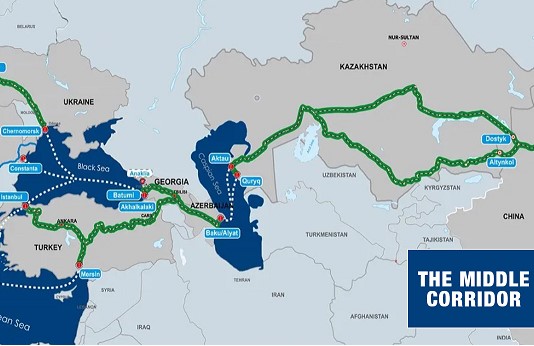
China plans to increase freight traffic with Europe in the near future via the Trans-Caspian International Transport Route (TCITR, “Middle Corridor”), which runs through Kazakhstan, the Caspian Sea, Azerbaijan, Georgia, and Turkey, bypassing the territory of the rf. The total length of the route exceeds 4,250 km, and its longest section runs through Kazakhstan’s territory.
Logistics via this corridor are considered more complex than transit through russia, as they combine rail transport, port infrastructure, ferry crossings, and complex customs procedures across several countries. However, Beijing and Astana are actively working on this project. The main reasons are russia’s toxicity, its status as a sanctioned entity, and its unreliability, as well as the desire to reduce relying on today’s unstable maritime routes.
To implement these plans, Kazakhstan Railways (KTZ) has announced its intention to invest approximately $10 billion in the modernization of railway, port, and terminal infrastructure by 2030. In 2026, the plan is to build 900 km of new railway tracks. Specifically, about 300 km on the Ayagoz–Bakhty section, which will create a third railway crossing on the border with China. This will increase the route’s capacity from 55 million to 100 million tons per year by 2030. To eliminate bottlenecks at sea, KTZ is investing over $100 million in six new cargo ships for voyages between the ports of Aktau, Kurik, and Baku.
Against this background, KTZ is preparing for an initial public offering (IPO) in 2026, with a possible listing in London, Hong Kong, and Kazakhstan. The funds raised will be used to modernize the rolling stock and expand the route network.
According to the Trans-Caspian International Transport Route Association, freight volumes through the corridor amounted to 2.76 million tons in 2023, 4.48 million tons in 2024, and 4.12 million tons in 2025. In the first quarter of 2026, approximately 173 trains, each carrying 55 containers, traveled along the route. KTZ’s annual target is 600 trains, and in 2027, this figure could increase by another 67%. According to analysts’ estimates, once the Trans-Caspian International Transport Route is fully operational, russia will permanently lose its status as a key transit hub between Asia and Europe, resulting in billions of dollars in losses for the country.