
minsk Trading with China at a Chronic Loss
3/9/2026
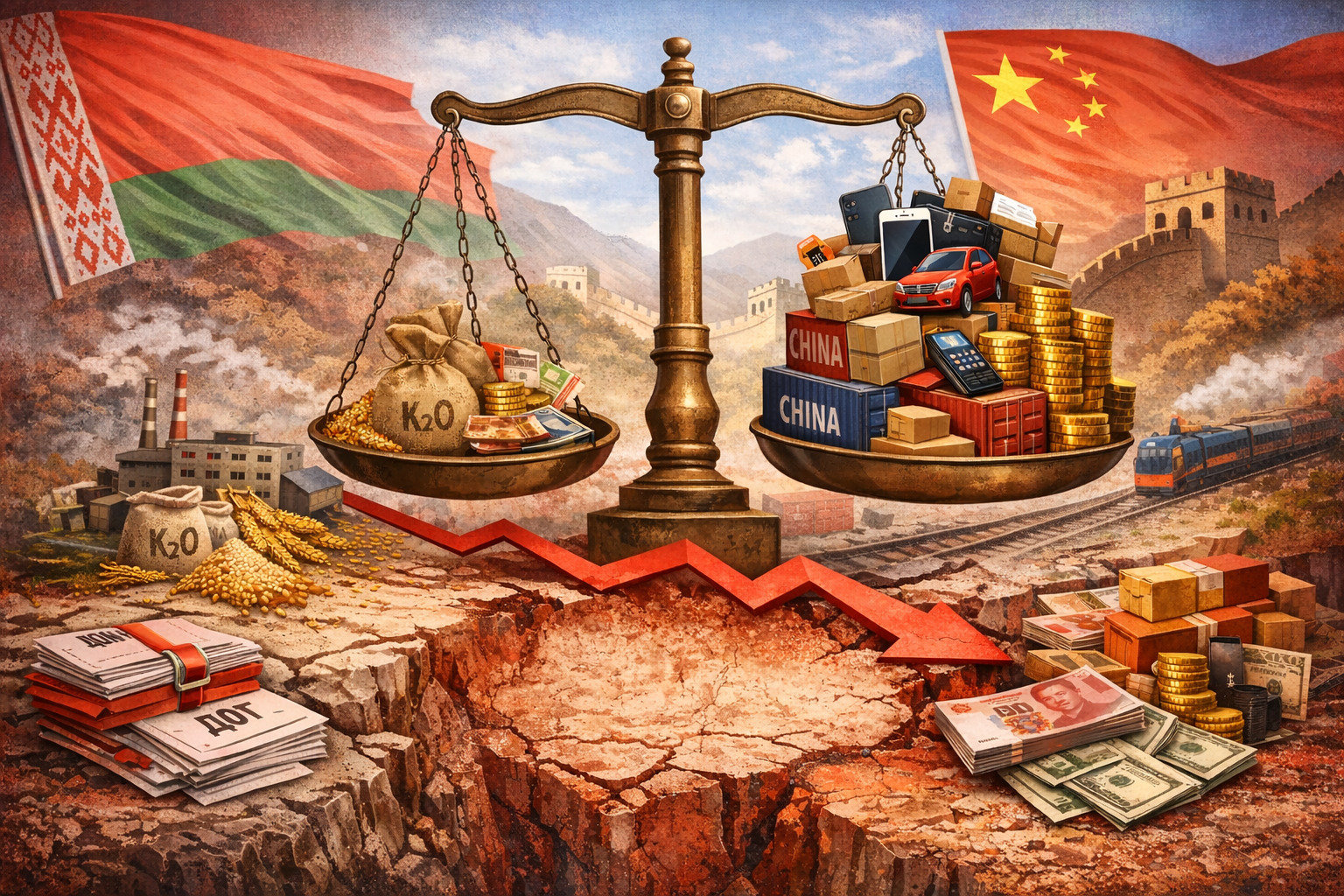
lukashenko’s five-year directive on cooperation with China for 2021–2025 has not been fulfilled. The dictator himself acknowledged this at a meeting on cooperation with China. A new directive is already being prepared with the task of “increasing China’s share in belarus’ total exports”. The rhetoric remains unchanged, as does the result.
The rb’s trade deficit with China has grown from less than $1 billion in 2019 to over $5.5 billion in 2025. Imports from China consistently exceed belarus’ exports, and the imbalance has become structural. In November 2025, the negative balance was $573 million, in December, it was $604 million. Not a single month between 2023 and 2025 saw a positive balance.
The commodity structure of trade leaves no room for optimism. belarus supplies China with potash fertilizers, some agricultural exports, and raw materials, i.e., products that do not require technological cooperation. On the other hand, Chinese imports – machinery, components, electronics, consumer goods, and equipment – are steadily pushing belarusian manufacturers out of the domestic market. belarus does not receive advanced technologies in significant volumes: technologically sensitive segments remain under Chinese control due to licenses and supply chain restrictions.
Macroeconomic losses from large-scale imports are distributed throughout the economy – through pressure on domestic producers and increased dependence on external supplies. At this, specific benefits of individual companies and contracts are actively promoted by state propaganda as evidence of a successful partnership.
belarus’ place in Chinese trade statistics is at the level of statistical error: 0.191% of Chinese exports and 0.064% of imports in 2025, compared to 0.072% and 0.044% respectively in 2019. belarus is more visible as a buyer of Chinese goods than as a supplier. For Beijing, this trade is a stable and low-risk flow. For minsk – it is an increasingly expensive dependency with a deficit that is financed through new debts and currency risks.
Logistics exacerbates the asymmetry: a significant part of the flow of goods between the two countries passes through the russian corridor, adding another level of dependence. In this arrangement, China is a partner with unlimited planning horizons and minimal risks. belarus (with increasingly fewer alternatives) is left to adapt to conditions which it does not determine itself.