
russia's Housing and Utilities Sector: Infrastructure Is Falling Apart, Rates Are Rising, There Is No Money
4/19/2026
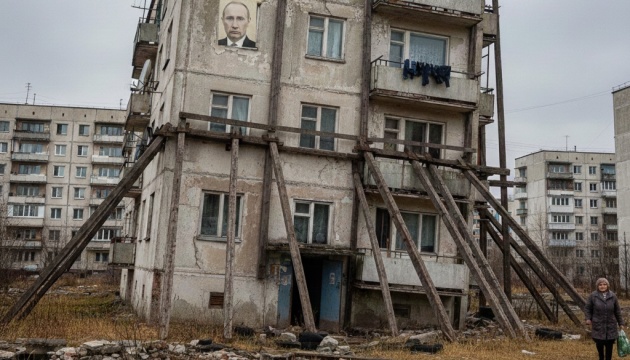
russia’s housing and utilities sector has entered a state of systemic collapse that official statistics can no longer conceal. The half worn out infrastructure, the nearly doubled number of accidents, and chronic underfunding – this is the picture effectively painted by deputy prime minister of the rf marat khusnullin, who in passing acknowledged the scale of the disaster that the kremlin had been hiding for years behind upbeat reports.
According to him, 80% of housing and utilities companies have no plans for infrastructure upgrades, about 30% of organizations are operating at a loss, a while the population’s debt for utility services has reached $8.9 billion. The degree of wear of networks has already exceeded 50%. In January 2026 alone, 1,788 utility accidents were recorded – nearly twice as many as in the same month of 2025.
There is money, but it is not there. Industry experts estimate the need for modernization at $114.9 billion. The state program until 2030 allocates exactly half that amount – $57.5 billion. The rest, it seems, has to be covered by corruption and complacency: management companies are accumulating debt, major repairs are being replaced with patchwork fixes, funds are being embezzled.
The war has made the already hopeless situation even worse. 64 out of 83 regions in russia have already cut budget spending on housing and communal services. In 2026, another 15 regions have planned spending cuts in this sector.
The kremlin’s response to the economic collapse has been to raise utility rates. In 2025, they rose by an average of 11.9% – the largest increase since 2016. A two-stage increase is planned for 2026: by 1.7% starting January 1 and by 8–22% starting October 1, depending on the region. The federal budget projects further growth of approximately 30% over the next three years. The stavropol territory (+22%), dagestan (+19.7%), tambov (+17.5%), and tyumen (+17.2%) regions will be hit the hardest. moscow – +15%, st. petersburg – +14.6%. Already now, housing and utility services account for about 10% of total household consumer spending.
Full-scale modernization of the sector amid a budget deficit and priority funding for the war is a political fiction. The government will continue to patch up the most problematic or politically sensitive regions instead of systematically upgrading the networks. Accidents will multiply, debts will grow, and the population will pay more for services that are getting worse and worse.
The deterioration of the housing and utilities sector is gradually ceasing to be merely a socio-economic problem. The worn-out utility infrastructure undermines regional governance and shatters one of the last myths of putin’s stability – the myth that at least homes are warm.