
The “Boeing Killer” That Doesn’t Exist: russia Is Again Imitating a Revolution in Aviation
4/29/2026
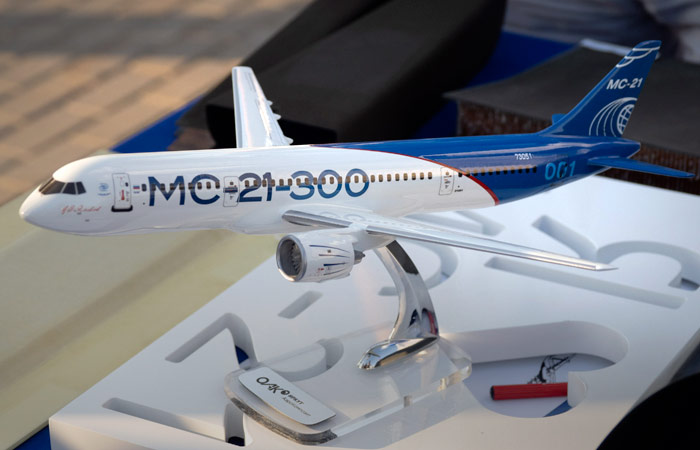
Against the background of the fiasco of russia's lunar exploration program and the “baikal” light aircraft, the kremlin continues to be obsessed with phantom dreams of the skies. russian propaganda has once again dusted off a story from several years ago about the “unrivaled” MS-21-310 medium-range aircraft, which, according to moscow, will become the “killer” of Boeing and Airbus.
Before the full-scale invasion of Ukraine, the prototype had not bad performance characteristics. In 2017, the MC-21-300, equipped with an American PW1400G engine and imported composites in its wing structure, had a takeoff weight of 72.56 tons and a maximum range of 5,100 km with a two-class cabin seating 175 passengers.
Following the introduction of anti-russian sanctions and import substitution, the new MS-21-310 version gained six tons in weight and has a maximum range of 3,830 km. The russian PD-14 engine requires significantly more fuel, which substantially increases the aircraft’s operating costs. In other words, flights between st. petersburg and krasnoyarsk still require an Airbus.
The A320neo has a range of 6,500 km, while the Boeing 737-800 has a range of 5,700 km. In other words, the MS-21-310 is already losing out to its competitors on the assembly line. russian aircraft designers have developed (on paper) a new, shorter version of the MS-21-210, which will be able to fly slightly farther than its predecessor but carry fewer passengers. Even local aviation experts say that aircraft with such specifications will be unpopular with domestic airlines.
The certification process has been postponed with a consistency worthy of a separate investigation: initially, 2023 was mentioned, then 2024, 2025, and 2026. Now they tentatively mention 2027. Currently, russia has three MS-21-310 aircraft undergoing flight tests, and as of early spring, nearly 30% of the required test volume has been completed. If the aircraft does go into production – and that is not guaranteed – the actual range in a commercial single-class configuration will be reduced to approximately 3,000 km. As is well known, russian designers have never been particularly concerned with passenger safety and comfort.
The reality is this: about 90% of passenger air travel in the country is still provided by Boeing and Airbus. To keep these planes in the air under sanctions, russian airlines resort to aircraft cannibalism – dismantling some planes to repair others. A country that dreams of building a “Boeing killer” survives on its spare parts.