
russia’s Petrol Shortage Has Spilled onto the Streets
6/26/2026
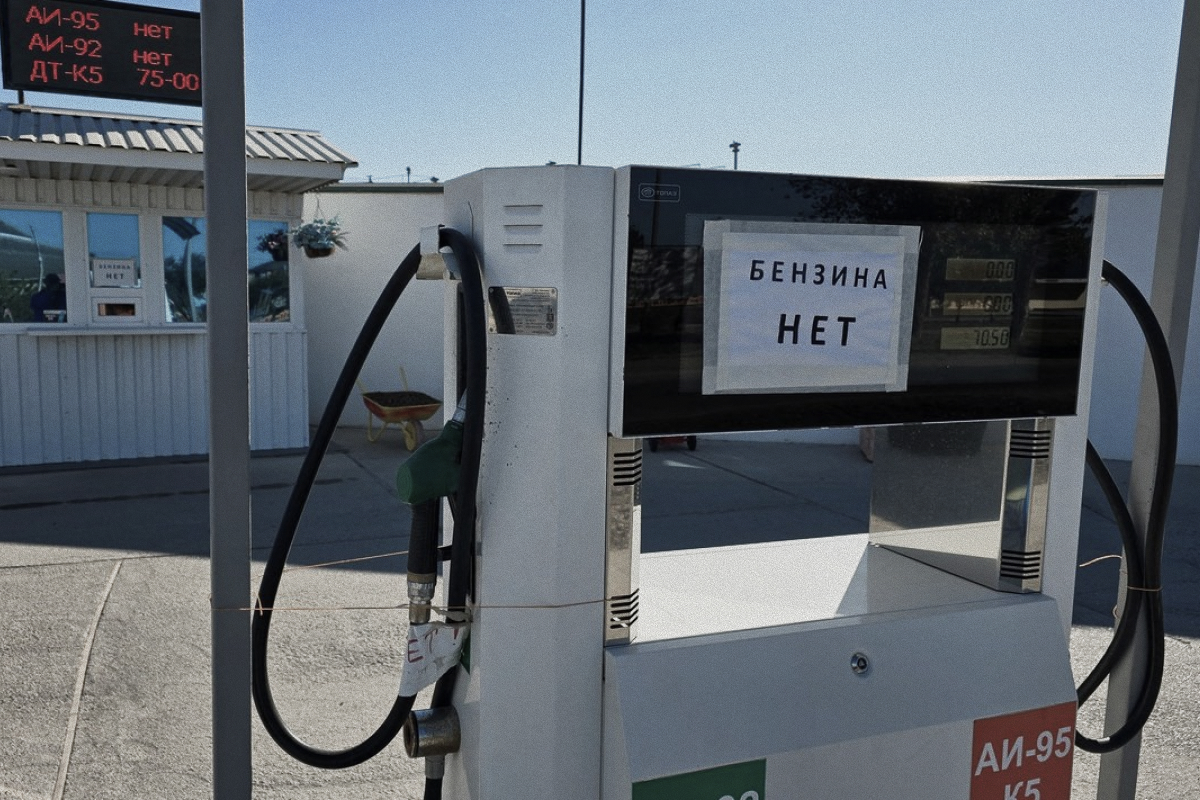
The systematic destruction of russia’s oil refining infrastructure has turned the fuel crisis from a story in the business media into a daily reality for millions of people. Petrol production has fallen by about 25%, and in the first week of June, oil refining volumes dropped below 4 million barrels per day – the lowest level in 21 years.
The consequences are no longer measured solely by prices at filling stations. The fuel shortage has disrupted public transportation in many regions. In the trans-baikal territory, the waste management operator “Oleron+” has halted rubbish collection in four districts, asking residents to “be understanding” and promising to clear the accumulated waste once the “situation normalizes” – no specific timeline has been provided. In the same trans-baikal territory, in the city of borzya, bus schedules have been reduced, and in chita, marshrutkas (shuttle minibuses) did not run at all because they were unable to refuel. In kaluga region, all suburban routes in ulyanovsky district have been canceled; in tula region, a carrier has announced the suspension of bus service in aleksin and kurkino; in rostov region, carriers are considering restrictions on intermunicipal routes.
Transportation costs are rising everywhere. In irkutsk, public transportation fares will rise to 45 rubles. In vladimir region, several carriers have requested fare increases. In moscow, st. petersburg, kazan, and yekaterinburg, taxis are operating only during rush hour to save fuel. Experts predict fare increases of 15–25%.
It is particularly telling that the crisis has affected oil-producing regions – something that has never happened before. Restrictions on fuel sales have been introduced in the khanty-mansi autonomous okrug, where about 40% of russia’s oil is produced. Limits have also been introduced in the neighboring tomsk region, while novosibirsk region is preparing similar measures. In sverdlovsk, chelyabinsk, orenburg, tyumen, and bashkortostan, some chain filling stations have suspended operations, while the rest have raised prices. In samara region, the limit is no more than 40 liters of petrol and 100 liters of diesel per fill-up; in saratov and nizhny novgorod regions, the limit is 30 liters each. The trans-baikal territory has gone even further: a “state of heightened readiness” has been declared there, fuel sales are limited to 15 liters per tank, fuel companies have been ordered to build up a monthly reserve for emergency services. Fuel is not being sold in jerry cans anywhere, but muscovites have already bought them up in shops – just in case.
Agriculture has been hit hard. In irkutsk region, farmers faced supply disruptions even during the planting season. For example, work in usolye district was halted due to a lack of fuel. Now the threat looms over the altai territory, which accounts for about 30% of production in the siberian federal district. member of the state duma of the rf from altai maria prusakova has stated that the price of fuel for farmers has risen 2.5 times over the past year. “People don’t know how to harvest hay, and the crop may be left in the fields,” she said. If the diesel shortage persists at the height of the harvest season, the entire food market will feel the consequences.
In total, restrictions on the purchase of petrol or diesel have already been introduced in 69 regions. Officially, however, only 29 have acknowledged this. Authorities in most regions continue to deny the crisis: bashkortostan has stated that there are no problems, even though limits are already in place there. governor of irkutsk region igor kobzev has acknowledged a “manual system” for fuel distribution prioritizing emergency services, but their employees claim they are also experiencing problems refueling. lipetsk governor igor artamonov has attributed the empty filling stations to an “acute shortage of fuel tankers”.
Against this background, chairman of the state duma’s healthcare committee sergei leonov has urged russians to “stop worrying and isolate themselves from information” about the fuel crisis. The authorities appear to have heeded their own advice: in the “max” messaging app, they have already begun blocking chats where fuel problems are discussed. Within a month, the number of search queries for “where to buy petrol” has increased 26-fold. Psychologists are observing “petrol anxiety” among russians – persistent stress caused by the inability to refuel or the fear of yet another price hike.