
The Occupying Authorities Are Imposing Imperial Myths on Students Instead of History
9/20/2026
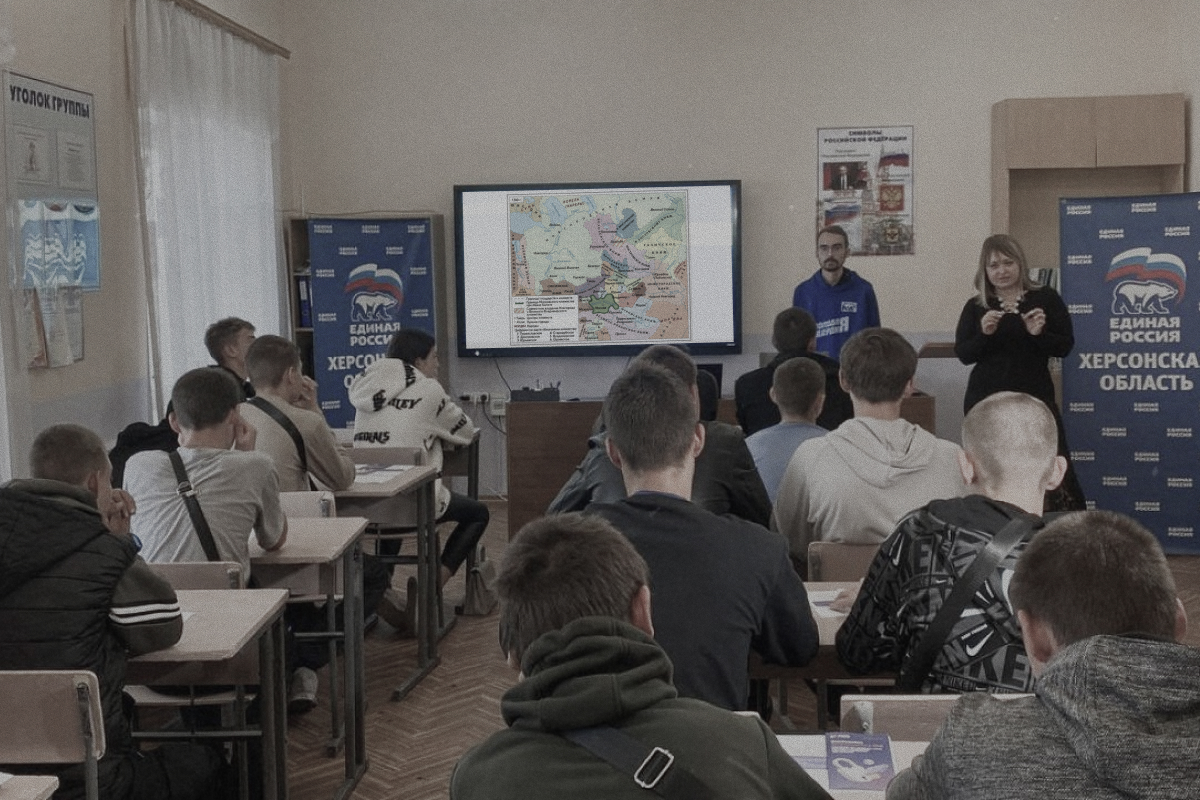
russia has embarked on a systemic rewriting of history for young people in the temporarily occupied territories of Ukraine. Following slogans about “returning home” and “one people”, the russian version of the past is being introduced into school curricula, in which Ukraine is gradually disappearing as a distinct historical and political reality.
The Foreign Intelligence Service of Ukraine has obtained teaching materials for the course “History of russia”, introduced for second-year students at the so-called “Kherson state pedagogical university” (located in Skadovsk) and “Kherson technical university” (located in Henichesk). The Foreign Intelligence Service of Ukraine has at its disposal presentations on the feudal fragmentation of Rus in the 11th –13th centuries and events of the early 20th century.
The materials are structured according to a simple principle: russia’s past is expanded, while Ukraine’s is downplayed. The Vladimir-Suzdal Principality is referred to as a “classic example of a Rus’ principality”, and its development is presented as the foundation of the future centralized russian state. According to this version, the grand ducal title shifted from Kyiv to the northeast as early as the mid-12th century.
The materials date the end of Kyivan Rus to 1169 – the year Kyiv was ravaged by the army of Andrei Bogolyubsky. From there, the narrative constructed to suit moscow’s interests unfolds: Kyiv – Volodymyr – moscow. This is precisely how russian historiography explains the shift of Rus’ center to the northeast and creates the appearance of direct continuity between Kyivan Rus and the russian state.
In this narrative, Ukrainians and Belarusians take a back seat. The Polans, Drevlians, and other East Slavic tribes are effectively reduced to “future russians, Ukrainians, and Belarusians”. Instead, maps and diagrams are dominated by “Rus’ land” and “rusichi” (“Rus’ people” – Transl.) – terms that blur the distinctions between medieval Rus and modern Russia.
Even Prince Volodymyr is portrayed in a way that serves russian propaganda. After the baptism of Rus, he is portrayed as a “gentle and benevolent ruler” who allegedly refrained from imposing the death penalty. The violent spread of Christianity is effectively glossed over. Novgorod is mentioned only in passing – with the phrase that it was “baptized by fire”.
Particular emphasis is placed on the inevitability of moscow’s rise to power. Of the fifteen old Rus lands, only three are examined in detail. Wars, conquests, and the forcible subjugation of other territories are pushed into the background. Instead, moscow’s annexation of those lands is presented as a natural stage of historical development.
The history of the russian empire is similarly rewritten. The authors of the presentations draw on the works of russian historian boris mironov to paint a picture of a supposedly successful empire without widespread impoverishment of the population. Revolutions and protests are explained as a result of growing social demands following reforms. Responsibility for the crisis is shifted onto the workers, who are supposedly “unaccustomed to working”. Meanwhile, the actions of Nicholas II and the ruling elite are excluded from the explanation of the causes of the revolution.
Military defeats are presented in the same way. The focus is on the heroism of the soldiers and the successful decisions of individual commanders. The Brusilov Offensive of 1916 is attributed to the “well-organized supply lines”, while the scale of russian losses remains outside the main narrative. The russian empire’s participation in World War I is reduced to the struggle for Constantinople and the Straits, leaving the imperial goals of the russian leadership out of the picture.
Similarly, russian propaganda posters from the First World War – “The Holy War” –“Mighty Rus” and others – are used without critical analysis. Students are not taught how war propaganda worked. Its imagery is, in fact, presented as part of a normal patriotic narrative.
This is not a random collection of distorted facts. russia is restructuring education in the occupied territories according to a single blueprint. The Ukrainian historical context is being replaced by the russian one; the invasion is presented as a “return”, while the history of the regions is portrayed as part of russia’s history. This approach is already being enshrined in the educational policy of the occupying administration of Kherson region for 2026–2030.
The goal of this effort is clear. They are attempting to impose a different historical narrative on the younger generation, which grew up in independent Ukraine. To this end, russia is removing inconvenient facts, changing terminology, rewriting the causes of events, and presenting conquest as a natural historical process.
By creating an artificial information vacuum through mythologization, sacralization, algorithmic scaling, and legitimization, russian propagandists are trying to permanently destroy the Ukrainian youth’s critical thinking in the temporarily occupied territories. The main goal of this system is to replenish the ranks of the army of loyal and obedient citizens of the rf.